
Pluralsight · 2024
Pluralsight Career Ladder
I kept asking what it would take to get promoted. Two directors got tired of it and put me on the team rewriting the career ladder. It's still in use.
- Tags
- Career Ladder · Systems · Workshop · Facilitation
Overview
Pluralsight’s career ladder was written in 2018 and had not kept up with what the jobs actually were. I was the person who wouldn’t stop asking what it would take to get promoted, so two directors put me on the team rewriting it. I was the only individual contributor in the room. We replaced a static ladder with a lattice, and then I ran the workshop that taught designers how to use it with their managers. It’s still how it works there.
A ladder written for jobs that no longer existed
The career ladder was built in 2018. By the time I got there it described a version of the company that had moved on. The titles were the same. The work behind the titles wasn’t.
That sounds like a documentation problem. It isn’t. When the ladder doesn’t match the job, every promotion conversation becomes a negotiation from scratch, and the outcome depends on how good your manager is at advocating for you rather than on what you actually did. People who are good at self-promotion do well. People who are good at their jobs sometimes don’t.
I know this because I was one of the people asking. I asked constantly. I asked my manager, I asked other managers, I asked anyone who might have an answer about what specifically I needed to do to reach the next level. Nobody could tell me, and it wasn’t because they were dodging. The document that was supposed to answer it didn’t describe the job anymore.
How I got in the room
Two directors were rebuilding the ladder and they pulled me onto the team. Not because I was senior. I was a mid-level product designer. They pulled me in because I was the squeakiest wheel in the org about leveling, and at some point it was easier to put me on the team than to keep answering me.
I was the only IC involved. There were more senior individual contributors available and none of them were in the room. I’ve thought about that a lot since. The lesson I took from it isn’t that persistence gets rewarded, because it mostly doesn’t. It’s that asking a question loudly and repeatedly, in public, for long enough, eventually makes you the person associated with the problem. And the people who own a problem get invited to the meetings where it gets solved.
They put me on the team because it was easier than answering me.
A lattice, not a ladder
The rename wasn't cosmetic. A ladder has one direction. A lattice lets you move sideways, and the thing we were actually fixing was that design careers at Pluralsight had stopped being one-dimensional.
Ladder
One direction. Up, or nowhere.
Lattice
Up, or sideways into another discipline.
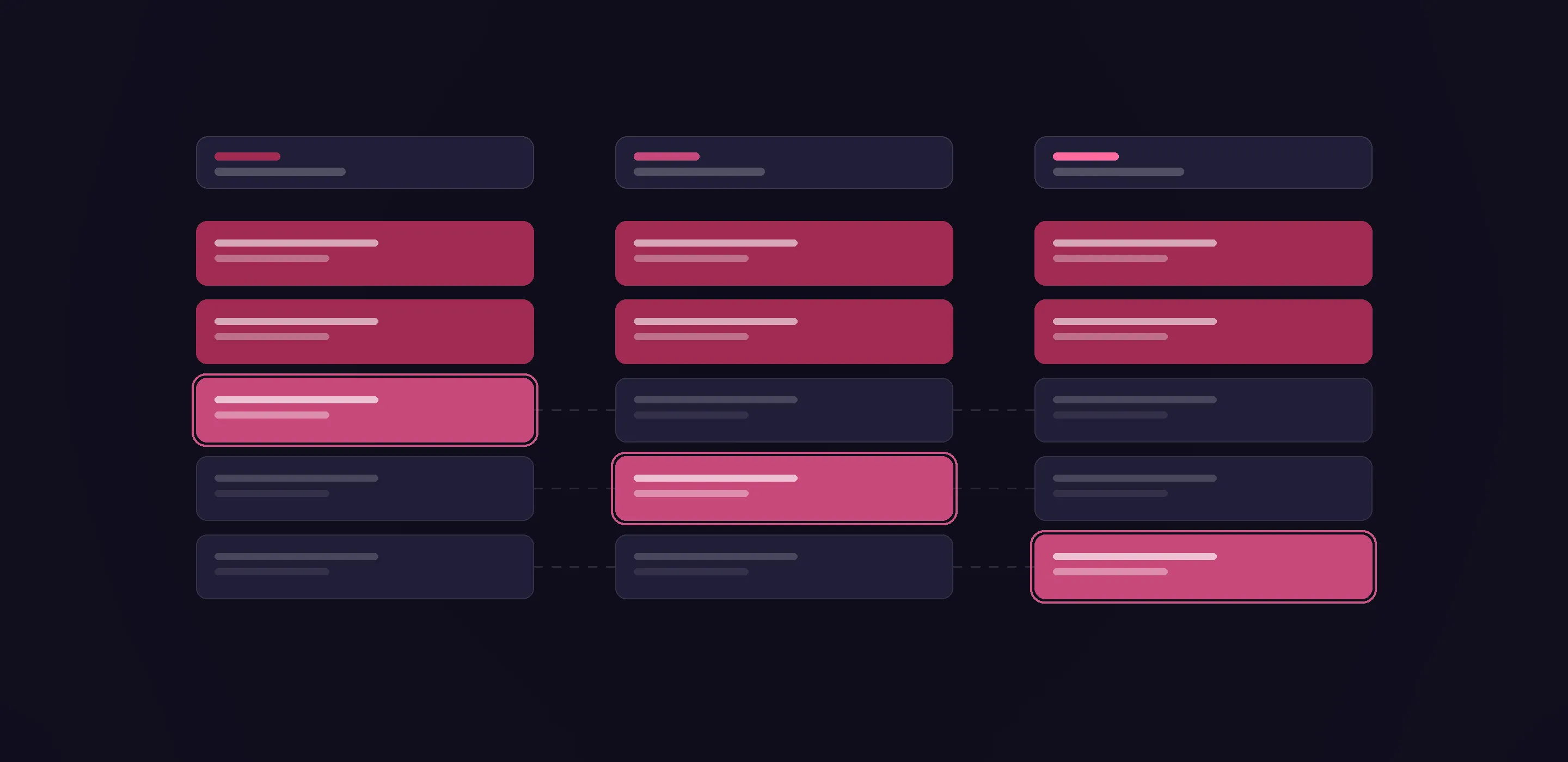
We built it around three functions rather than one track: design, research, and content. Each person carries a set of capabilities. Some are required of everyone, some come with the function, and the rest are theirs to pick.
That structure does something a ladder can’t. It makes the overlap between disciplines visible. A product designer who wants to get better at research can see exactly which capabilities that means, and those aren’t a detour off the track, they’re on the board. Growth stops being only vertical.
What was actually on the board
A role broke into three parts: the capabilities you carry, the function you focus on, and the level you operate at. The capabilities themselves came in three tiers.
Role
The whole view of the person. Your job title might be Product Designer, but you function on the team as, say, a UX strategist.
Capabilities
The skills, mindsets, and behaviors the work needs. Each person carries 16 to 20 in a year.
Focus
The functions a person is primarily responsible for: design, research, content.
Levels
An org-wide leveling framework: the experience, autonomy, and scope expected at each career level.
Content
- Writing
- Content & Information Design
- Content Strategy
Design
- Interaction Design
- Visual Design
- Information Architecture
Research
- Discovery
- Execution
- Synthesis
- Systems Thinking
- Critical Thinking
- Data-informed decision-making
- Communication & Storytelling
- Community Building
- Human Focus
- Collaboration
- Accessibility
- Conceptual Thinking
- Product Thinking
- Product Operations
- Technology
- Process & Governance
- Service Design
- Leadership
- Learning Science
- Experimentation
- Research: Discovery
- Research: Execution
- Research: Synthesis
Everyone is accountable for the Core. Your Practice comes with the job. Your Focus areas are yours to pick, and they can switch each year when your interest and a real business need line up. This is your job title, but this is your job.
P1 Understanding · P2 Growing · P3 Achieving · P4 Guiding · P5 Innovating
One person, read across the lattice: a product designer moving into research. Senior in craft, just starting in research. A ladder would force a single rung. The lattice shows all of it at once.
How you actually use it
The part I care most about is that it's a procedure, not a document. Here is the whole thing.
1. Self-assess
Start with an honest self-assessment against the lattice. Before anyone else’s opinion, yours.
2. Find yourself on the lattice
Pick your function. Design, research, or content.
3. Pull your core
Drag over the tiles everyone carries, whatever your function. These aren’t optional. They’re what the job is.
4. Choose your focus
Pick the four to seven focus areas you’ll grow this year. Your call, not your manager’s.
5. Take it to your manager
Bring the whole thing to a 1:1 and check that what you want to learn lines up with the business goals and your team’s goals.
6. Make a plan together
Work out with your manager how you actually improve in those areas, then revisit it each quarter.
Two things about that sequence matter more than the rest.
The first is splitting the core from the focus. The core is what everyone carries, whatever your function, and it isn’t negotiable. The focus areas you pick are yours. That separation is what keeps the thing from being either a performance review in disguise or a wishlist with no teeth. You have obligations and you have direction, and they’re different columns.
The second is cadence. Your focus areas reset once a year, but you revisit them in your regular 1:1s instead of once at review time. A ladder you look at annually is a verdict. A lattice you keep checking is a conversation. That is what moved growth out of the annual review and into the work, which is where it was always supposed to live.
We tested it before we shipped it
Before the lattice went anywhere near the whole org, we ran a trial. We invited a handful of designers to use the draft version, do the steps, and tell us where it broke.
That sounds obvious written down. It isn’t what usually happens. Career frameworks get written by leadership, announced, and then everyone quietly works out that the levels don’t describe anyone’s actual job. That is precisely how the 2018 ladder had gotten into the state we found it in.
So we treated it like a product. Draft, put it in front of real users, watch where they got stuck, revise. The version that shipped was version four. The feedback round is the reason it was version four and not version one.
Building the thing is half of it
A career framework that nobody knows how to use is a PDF in a folder. I’ve watched that happen. The document is fine and it dies anyway, because “here’s the new ladder, go read it” asks every person in the org to figure out on their own what to do with it.
So I ran a workshop for the designers. Not a presentation about the philosophy of the lattice. A working session where I walked them through the six steps live and they did each one as we went. Self-assess. Pick your role. Pull your core tiles. Choose your three. Draft what you’d say to your manager.
The workshop ran as part of Summit Camp, a virtual design summit three other designers and I put together. We wanted an onsite and there was no budget for one, so we built the online version instead and used it to get the whole design community, somewhere in the neighborhood of forty people, in the same place for a few days. That’s also why the workshop reached as many people as it did. I wasn’t hoping designers would show up to a session about the career lattice. They were already there.
Everyone walked out with the finished artifacts in hand, ready to take into their next 1:1. That was the whole design of it. Not “you now understand the lattice,” but “you are holding the thing you need for Tuesday.”
I’m more proud of that than of the framework. The framework was three of us in a room. The workshop is why it survived.
The current state
Where it is now
It’s still in use at Pluralsight. I’ve been gone a while, and coworkers who are still there tell me the lattice is still how designers plan their growth and run that part of their 1:1s.
That’s the outcome I’d point at. Not that it shipped, but that it kept working without anyone maintaining it, in an org that had already let one career ladder go stale for years. Something built by three people in a room became the default way a function thinks about growth, and it outlasted all of us being there to defend it.
- Sustained performance at the next level You control this
- Time in level Mostly out of your hands
- Business need Leadership can influence
- Budget available Can't control
- Open promotion spots Can't control
Even with every capability at the top level, a promotion still needs business need, budget, and an open spot. Some of that a designer can influence. Some of it nobody in design can.
I did not get promoted. People who used the lattice did. I find that funnier than I probably should.
What I’d actually take from it is narrower and more useful than a promotion would have been. I learned that the artifact is not the deliverable. The adoption is. I built the framework with two directors and it would have sat there if I hadn’t also built the hour that taught the rest of the org how to use it. Every piece of systems work I’ve done since, the design system included, I’ve planned the adoption before I’ve planned the thing.
Next case study
Pluralsight Leader Hub
Analytics was our number one driver of churn. There was no leader dashboard, so I built one from zero. Deep data for the leaders who wanted it, a glance for the ones who didn't.